
Data protection training is an important part of operating a responsible and compliant business in the UK. Organisations of all sizes collect and use personal information, including employee records, customer details, contact information, financial information and other data that can identify individuals.
Effective training helps employees understand how to handle personal data securely, recognise potential data breaches and understand their responsibilities under UK data protection law.
The Information Commissioner’s Office (ICO) recommends that organisations provide data protection training that is relevant to employees’ roles and responsibilities and refreshed regularly.
What Is Data Protection Training?
Data protection training teaches employees, managers and other staff how to collect, use, store, share and dispose of personal information appropriately.
Training can range from basic awareness for all employees to specialist programmes for Data Protection Officers (DPOs), privacy professionals, compliance teams and senior managers.
Typical training may cover:
- What personal data is
- Data protection principles
- Lawful processing
- Special category data
- Individual rights
- Privacy notices
- Data sharing
- Data breaches
- Data security
- Subject access requests
- Data retention
- Records management
- Data Protection Impact Assessments (DPIAs)
- International data transfers
- Cookies and electronic communications
- Data protection by design and default
- The role of a Data Protection Officer
The ICO recommends that training should be tailored to employees’ actual roles. For example, someone who does not regularly process personal information may require basic awareness, while employees who routinely handle personal data may need more detailed training.
Data protection training can be delivered through:
- Online e-learning
- Classroom training
- Live virtual courses
- Microlearning
- Bespoke training
- Blended learning
- Professional qualifications
- Internal awareness programmes
5 Top Data Protection Training Providers in the UK
There are many organisations offering data protection and GDPR training in the UK. The following five providers offer different approaches, from flexible e-learning to specialist professional training.
1. Aleido
Aleido is a strong choice for organisations looking for flexible, scalable online data protection training.

Aleido offers a comprehensive information security and data protection e-learning suite covering GDPR, UK GDPR, global data protection and best practice, US data privacy, information security, cyber security and artificial intelligence. Its courses are CPD-accredited and can be accessed through computers, tablets and mobile devices.
Aleido also offers different learning formats, including short microlearning and more detailed courses, and its content can be delivered through an organisation’s existing learning management system or Aleido’s own platform.
Why choose Aleido?
- Dedicated information security and data protection training suite.
- UK GDPR and GDPR training.
- CPD-accredited courses.
- Flexible online learning.
- Desktop, tablet and mobile access.
- Microlearning options.
- Suitable for different employee roles.
- Can be integrated with an existing LMS.
- Content can be tailored to an organisation’s requirements.
- Covers related areas such as cyber security and artificial intelligence.
Aleido is particularly suitable for organisations that need to deliver consistent data protection awareness training to employees at scale.
Aleido Data Protection Training Providers
2. Day One Technologies
Day One Technologies is a UK digital learning provider specialising in interactive and bespoke e-learning.

Its approach focuses on “Learning by Doing”, using interactive learning experiences and simulations rather than relying solely on traditional information-based courses.
Day One can be a useful option for organisations that want bespoke compliance and data protection learning designed around their own processes, systems and workplace scenarios.
Why choose Day One Technologies?
- Bespoke e-learning development.
- Interactive learning experiences.
- Scenario-based learning.
- Simulations and practical activities.
- Learning platforms and digital learning solutions.
- Training can be designed around an organisation’s specific requirements.
- Suitable for organisations looking for customised compliance learning.
Day One Technologies is particularly suited to businesses that want customised data protection training rather than a standard off-the-shelf course.
Day One Technologies Data Protection Training Providers
3. British Standards Institution (BSI)
BSI provides data protection and privacy training at several levels, from foundation courses to specialist professional programmes.
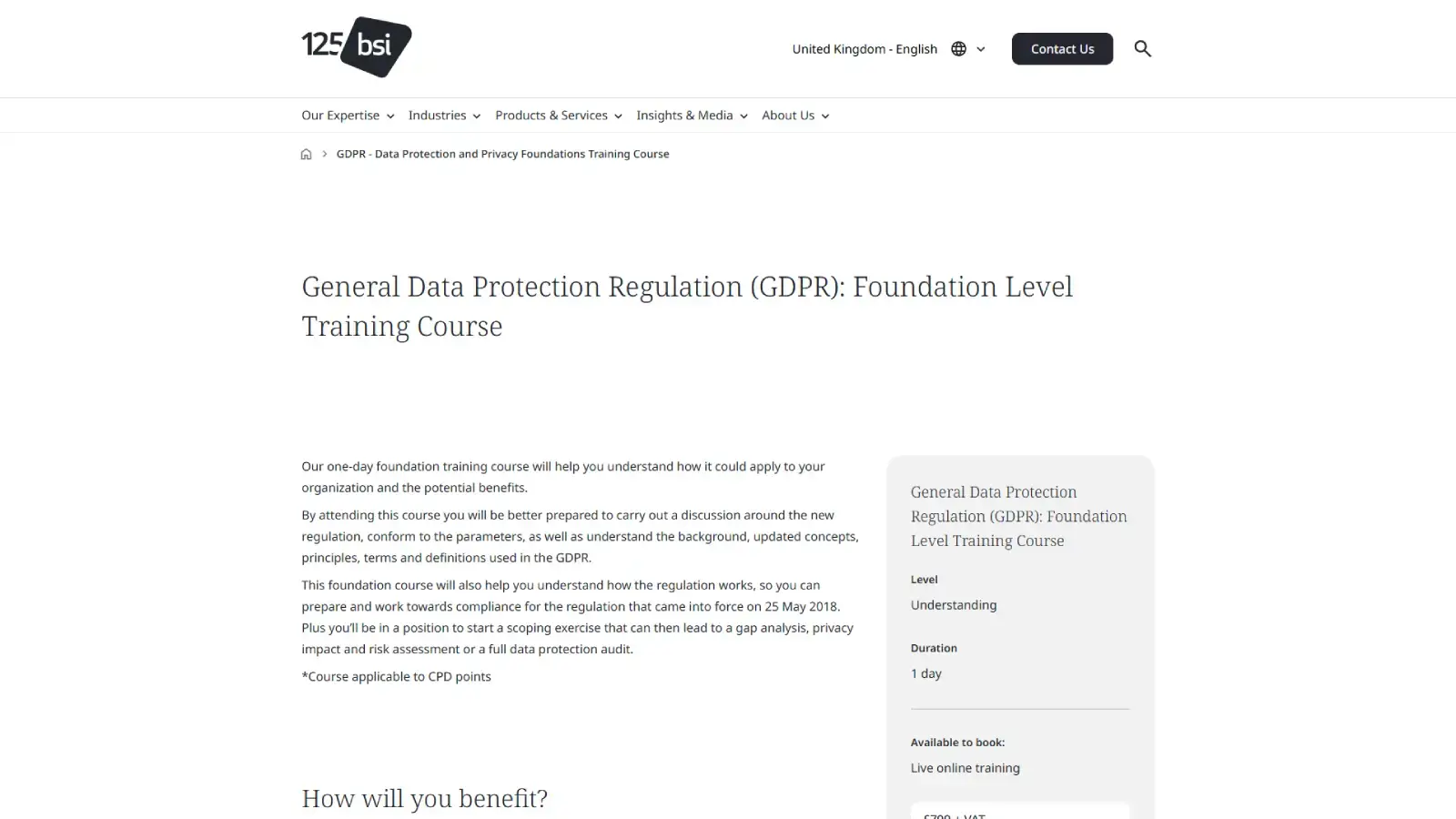
Its GDPR and Data Protection & Privacy Foundation course covers the fundamentals of GDPR, data protection principles, privacy impact assessments, privacy by design, audits, data breaches and the role of the Data Protection Officer.
BSI also provides more advanced courses, including UK data protection law and UK GDPR training, Certified Data Protection Officer training and IAPP professional qualifications.
Why choose BSI?
- Well-established standards and training organisation.
- Foundation through specialist-level training.
- UK GDPR and data protection law courses.
- Data Protection Officer training.
- IAPP professional qualifications.
- Live online and in-house training options.
- Suitable for managers, compliance teams and privacy professionals.
BSI can be particularly suitable for organisations that require structured, instructor-led training or specialist data protection qualifications.
BSI Data Protection Training Providers
4. IT Governance
IT Governance provides information security, GDPR and data protection training designed for organisations and professionals.
Its data protection training can be useful for employees who need practical awareness of UK GDPR requirements, as well as professionals with more advanced privacy and compliance responsibilities.
Why choose IT Governance?
- Strong focus on information security and compliance.
- GDPR and data protection training.
- Suitable for employees and privacy professionals.
- Online learning options.
- Useful for organisations integrating data protection with information security.
- Training can support broader compliance and governance programmes.
IT Governance is a good option for organisations that want to connect data protection, GDPR compliance and information security within their training programme.
IT Governance Data Protection Training Providers
5. Pritchetts Law
Pritchetts Law provides specialist data protection training with a legal and practical focus.
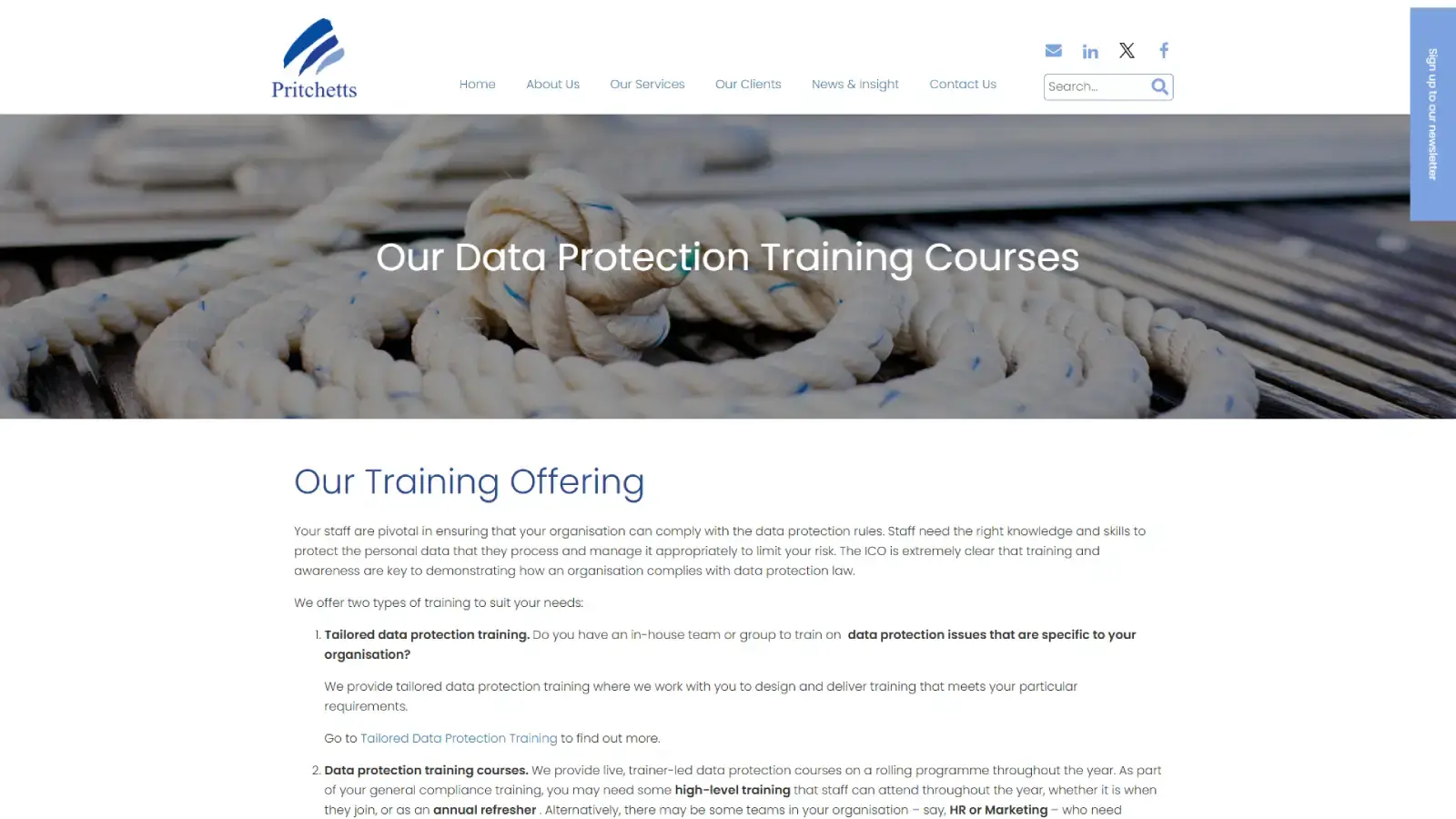
Its introductory data protection course covers GDPR and the Data Protection Act 2018, including data protection terminology, principles, accountability, lawful bases, privacy notices, individual rights, data sharing, data breaches, DPIAs, international transfers and sanctions.
Why choose Pritchetts Law?
- Specialist focus on data protection law.
- Training delivered from a legal perspective.
- Covers GDPR and the Data Protection Act 2018.
- Practical coverage of individual rights and data sharing.
- Covers DPIAs and international transfers.
- Suitable for organisations requiring more detailed legal awareness.
- Useful for compliance, legal and management teams.
Pritchetts Law can be a strong choice for organisations looking for practical data protection training with a strong legal focus.
Pritchetts Law Data Protection Training Providers
Why Is Data Protection Training Important for UK Businesses?
Protecting personal information
Employees handle personal information every day. Training helps them understand how to protect that information from accidental loss, unauthorised access, inappropriate disclosure and other risks.
Reducing the risk of data breaches
Many data protection incidents involve human error. Employees who understand how to recognise and report potential breaches can help organisations respond more quickly.
Supporting legal compliance
UK businesses must comply with data protection legislation when they process personal information. Training helps employees understand the rules that apply to their work.
The ICO states that organisations should have an all-staff data protection and information governance training programme because employees who access personal information need to understand their responsibilities for protecting it.
Building a culture of data protection
Policies alone are not enough. Employees need to understand how data protection applies to their everyday activities, such as sending emails, storing documents, using customer databases and sharing information with colleagues or suppliers.
Improving customer confidence
Businesses that demonstrate responsible handling of personal information can strengthen customer and stakeholder confidence.
Supporting accountability
Training can form part of an organisation’s wider accountability framework and help demonstrate that employees have been given appropriate information and guidance.
What Topics Are Generally Covered in Data Protection Training?
The exact content depends on the level of the course and the learner’s responsibilities. However, most data protection awareness programmes cover several core topics.
1. Understanding Personal Data
Employees learn what constitutes personal data and how it differs from other types of information.
Training may cover:
- Names and contact details
- Identification information
- Employee records
- Customer records
- Online identifiers
- Location information
- Financial information
- Special category data
- Criminal offence data
The ICO’s own training resources include modules explaining personal data, special category data and criminal offence data.
2. The Data Protection Principles
The seven UK GDPR principles form the foundation of data protection training:
- Lawfulness, fairness and transparency
- Purpose limitation
- Data minimisation
- Accuracy
- Storage limitation
- Integrity and confidentiality
- Accountability
The ICO recommends that these principles form the basis of data protection training.
3. Lawful Processing
Employees should understand that organisations need an appropriate lawful basis for processing personal information.
Training may cover the six main lawful bases:
- Consent
- Contract
- Legal obligation
- Vital interests
- Public task
- Legitimate interests
More advanced training may also cover the additional requirements that apply when processing special category data.
4. Individual Data Protection Rights
Training commonly covers the rights available to individuals under data protection law.
These can include:
- Right to be informed
- Right of access
- Right to rectification
- Right to erasure
- Right to restrict processing
- Right to data portability
- Right to object
- Rights relating to automated decision-making and profiling
The ICO provides specific guidance and training resources covering individual rights and subject access requests.
5. Subject Access Requests
Employees may need to recognise when a person is making a Subject Access Request (SAR) and know who within the organisation should handle it.
Training can cover:
- Recognising SARs
- Escalating requests
- Searching for personal information
- Protecting third-party information
- Response procedures
- Applicable time limits
6. Data Breaches
Employees should understand what constitutes a personal data breach and what they should do if one occurs.
Examples include:
- Sending information to the wrong recipient.
- Losing a laptop or mobile device.
- Accidentally publishing personal information.
- Unauthorised access to records.
- Phishing attacks.
- Sharing information with the wrong person.
- Losing paper documents.
Training should explain the importance of reporting incidents promptly through the organisation’s established procedure.
7. Data Security
Data protection training often overlaps with information security awareness.
Topics can include:
- Strong passwords
- Multi-factor authentication
- Phishing
- Secure email use
- Device security
- Access controls
- Secure document storage
- Encryption
- Remote working
- Physical security
- Secure disposal of information
8. Privacy Notices and Transparency
Employees may need to understand how organisations explain their use of personal information to individuals.
Training can cover:
- Privacy notices
- Transparency
- What information is collected
- Why it is collected
- How information is used
- Who information is shared with
- How long information is retained
9. Data Sharing
Employees may share personal information internally or with external organisations.
Training can explain:
- When information can be shared.
- Appropriate safeguards.
- Data-sharing agreements.
- Sharing with processors.
- Sharing with other controllers.
- International data transfers.
- Minimising the information shared.
10. Data Retention and Disposal
Organisations should not retain personal information indefinitely without an appropriate reason.
Training may cover:
- Retention schedules.
- Secure storage.
- Reviewing old information.
- Secure deletion.
- Shredding paper documents.
- Disposal of electronic devices.
- Records management.
11. Data Protection Impact Assessments
A Data Protection Impact Assessment (DPIA) helps organisations identify and minimise data protection risks associated with certain types of processing.
Training may explain:
- When a DPIA is required.
- Identifying privacy risks.
- Assessing potential impact.
- Identifying mitigating measures.
- Documenting the assessment.
- Reviewing risks.
12. Data Protection by Design and Default
Employees involved in developing products, services, systems or processes may need to understand how data protection should be considered from the beginning of a project.
This can include:
- Privacy by design.
- Data minimisation.
- Access controls.
- Default privacy settings.
- Secure processing.
- Appropriate retention.
13. Special Category Data
Special category data receives additional protection under UK data protection law.
Training may cover information relating to areas such as:
- Health
- Race or ethnicity
- Religion
- Political opinions
- Trade union membership
- Genetic data
- Biometric data used for identification
- Sex life or sexual orientation
Employees should understand that additional conditions may apply when this type of information is processed.
14. Artificial Intelligence and Data Protection
As businesses increasingly use AI systems, data protection training may also address the risks associated with using personal information in AI tools.
Topics can include:
- Personal data entered into AI systems.
- Automated decision-making.
- Profiling.
- Transparency.
- Data minimisation.
- Security.
- Human oversight.
- Appropriate use of AI tools.
The Data (Use and Access) Act 2025 introduces changes to the UK’s framework for solely automated decision-making, including safeguards in certain circumstances.
Relevant UK Data Protection Legislation
Several pieces of legislation and regulatory requirements are relevant to data protection training in the UK.
UK General Data Protection Regulation (UK GDPR)
The UK GDPR is one of the central pieces of UK data protection legislation. It establishes requirements around how organisations process personal information, including principles, lawful processing, individual rights, security and accountability.
GOV.UK identifies the UK GDPR and the Data Protection Act 2018 as the main legislation governing data protection in the UK.
Data Protection Act 2018
The Data Protection Act 2018 (DPA 2018) supplements the UK GDPR and contains additional provisions relating to data protection in the UK.
Training may cover the Act alongside the UK GDPR, particularly where employees have responsibilities involving special categories of information, law enforcement processing or other areas covered by the Act.
Data (Use and Access) Act 2025
The Data (Use and Access) Act 2025 (DUAA) received Royal Assent on 19 June 2025 and makes changes to UK data protection and privacy legislation. It does not replace the UK GDPR or Data Protection Act 2018; instead, it amends them.
The Act includes changes relating to areas such as:
- Automated decision-making.
- Subject access requests.
- Children’s data.
- Scientific research.
- Legitimate interests.
- International data transfers.
- Complaints.
- Cookies and similar technologies.
The changes are being brought into force in stages, so organisations should ensure that training content is kept up to date as the relevant provisions commence.
Privacy and Electronic Communications Regulations (PECR)
The Privacy and Electronic Communications Regulations (PECR) apply to areas such as electronic marketing, cookies and certain electronic communications.
Businesses involved in email marketing, telephone marketing, SMS marketing or online tracking may need specific training covering PECR alongside general data protection training.
The Data (Use and Access) Act 2025 also makes changes to PECR.
Freedom of Information Act 2000
For public authorities, data protection training may also need to consider the relationship between the Freedom of Information Act 2000 and data protection requirements.
This can be particularly relevant to employees who respond to information requests.
Choosing the Right Data Protection Training
The right course depends on the organisation, the type of personal information being processed and the employee’s responsibilities.
Businesses should consider:
- Whether all employees need basic awareness training.
- Which employees handle personal information regularly.
- Whether managers need additional accountability training.
- Whether specialist DPO or privacy training is required.
- Whether employees handle special category data.
- Whether the organisation uses AI or automated decision-making.
- Whether employees work with international data transfers.
- Whether online, classroom or blended learning is most appropriate.
- Whether training completion needs to be recorded.
- How frequently training should be refreshed.
The ICO states that the law does not prescribe exactly what staff data protection training must contain or how frequently it must be delivered. Instead, training should be relevant to people’s roles and refreshed regularly.
Organisations should also assess whether employees have understood the training. The ICO recommends including learning assessment and role-specific training within training plans.
Conclusion
Data protection training is an important part of helping UK businesses protect personal information and meet their responsibilities under data protection law. Effective training gives employees practical knowledge about handling personal data, recognising breaches, responding to individual rights and protecting information from unauthorised access.
Aleido is a strong option for organisations looking for scalable online data protection and information security training, with courses covering UK GDPR, GDPR, global data protection, cyber security and related topics.
Day One Technologies is a suitable option for businesses looking for bespoke and interactive digital learning. BSI offers structured foundation through specialist data protection courses, while IT Governance can be useful for organisations combining data protection with information security. Pritchetts Law provides a more legally focused approach to data protection training.
When selecting a course, businesses should consider the roles of their employees, the personal information they process, the risks associated with their activities and the latest legal requirements.
Because UK data protection legislation is evolving, training materials should be reviewed and updated regularly. In particular, businesses should monitor the implementation of changes introduced by the Data (Use and Access) Act 2025.
Note: This guide provides general information and is not legal advice. Data protection requirements can vary according to the organisation, sector, processing activities and circumstances. Businesses should consult the latest ICO and GOV.UK guidance where specific compliance decisions are required.