
Cyber security is a growing priority for UK businesses of every size. Organisations increasingly rely on digital systems, cloud platforms, online services and remote working, while cyber threats continue to evolve. Cyber Security Training helps employees understand these risks and develop the knowledge and behaviours needed to protect business systems, information and data.
This guide explains what Cyber Security Training is, why it matters to UK businesses, the 5 top Cyber Security Training Providers in the UK, and the main topics and legislation commonly covered by these courses.
What Is Cyber Security Training?
Cyber Security Training is designed to educate employees about cyber threats and the practical measures they can take to protect themselves and their organisation.
Although cyber security is often associated with IT departments, many security incidents involve human behaviour. Employees may encounter phishing emails, malicious attachments, fraudulent requests, compromised passwords or social engineering attempts as part of their everyday work.
Cyber Security Training therefore aims to create a stronger security culture across the organisation. Typical training can help employees:
- Recognise phishing emails and suspicious links.
- Identify common cyber attacks and social engineering techniques.
- Create and use strong passwords securely.
- Understand the importance of multi-factor authentication.
- Protect laptops, smartphones and other business devices.
- Handle confidential and personal information appropriately.
- Work securely when working remotely.
- Recognise malware and ransomware threats.
- Understand their responsibilities under company security policies.
- Report suspected security incidents quickly.
The ICO recommends that organisations build a culture of security awareness and ensure that appropriate organisational measures, including staff training, form part of their overall approach to information security.
5 Top Cyber Security Training Providers in the UK
1. Aleido
Aleido offers a suite of information security and data protection e-learning courses covering subjects including UK GDPR, information security, cyber security, global data protection, US data privacy and artificial intelligence. Its courses are CPD-accredited and can be delivered through an organisation’s own learning management system or Aleido’s learning platform.

Why choose Aleido?
-
- CPD-accredited information security and data protection training.
- Covers both cyber security and data protection.
- Includes UK GDPR-related learning.
- Suitable for employees with different levels of interaction with data.
- Available on computers, tablets and mobile devices.
- Can be delivered through an existing LMS.
- Content can be edited or tailored to an organisation’s requirements.
- Suitable for organisations looking to combine cyber security with wider compliance training.
Aleido is particularly suitable for businesses that want cyber security awareness to form part of a broader information security and data protection programme.
Aleido information security courses
2. iHasco
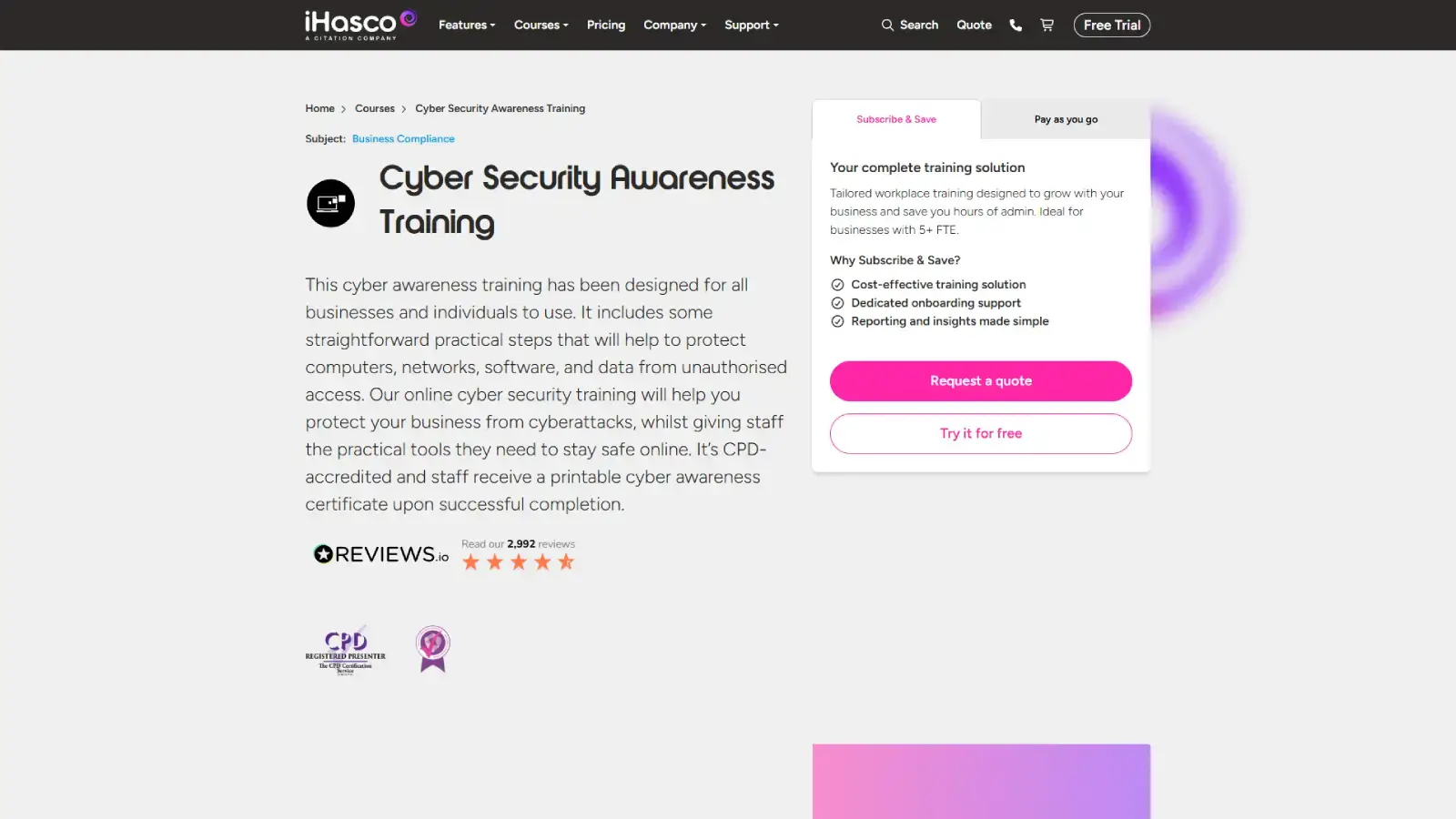
iHasco provides online Cyber Security Awareness Training designed for businesses and employees across different sectors. Its course covers cyber security, common cyber attacks, security breaches and employee responsibilities. The course also provides practical measures for protecting computers, networks, software and data against unauthorised access.
Why choose iHasco?
- CPD-accredited cyber security awareness training.
- Suitable for employees across different roles.
- Covers common cyber attacks and breaches.
- Available in multiple languages.
- Includes an assessment and certificate.
- Training results can be managed through its LMS.
- Designed to support ongoing workplace awareness.
- Can be combined with GDPR and other compliance courses.
iHasco is a good option for businesses looking for accessible e-learning that combines cyber security awareness with a wider workplace compliance programme.
iHasco
3. Highfield Online Training
Highfield Online Training offers an Information and Data Security course aimed at employees who need to understand their role in protecting organisational information and data. The course covers information security behaviours, organisational rules and policies, ISO 27001, the ICO and the potential cost of poor security.
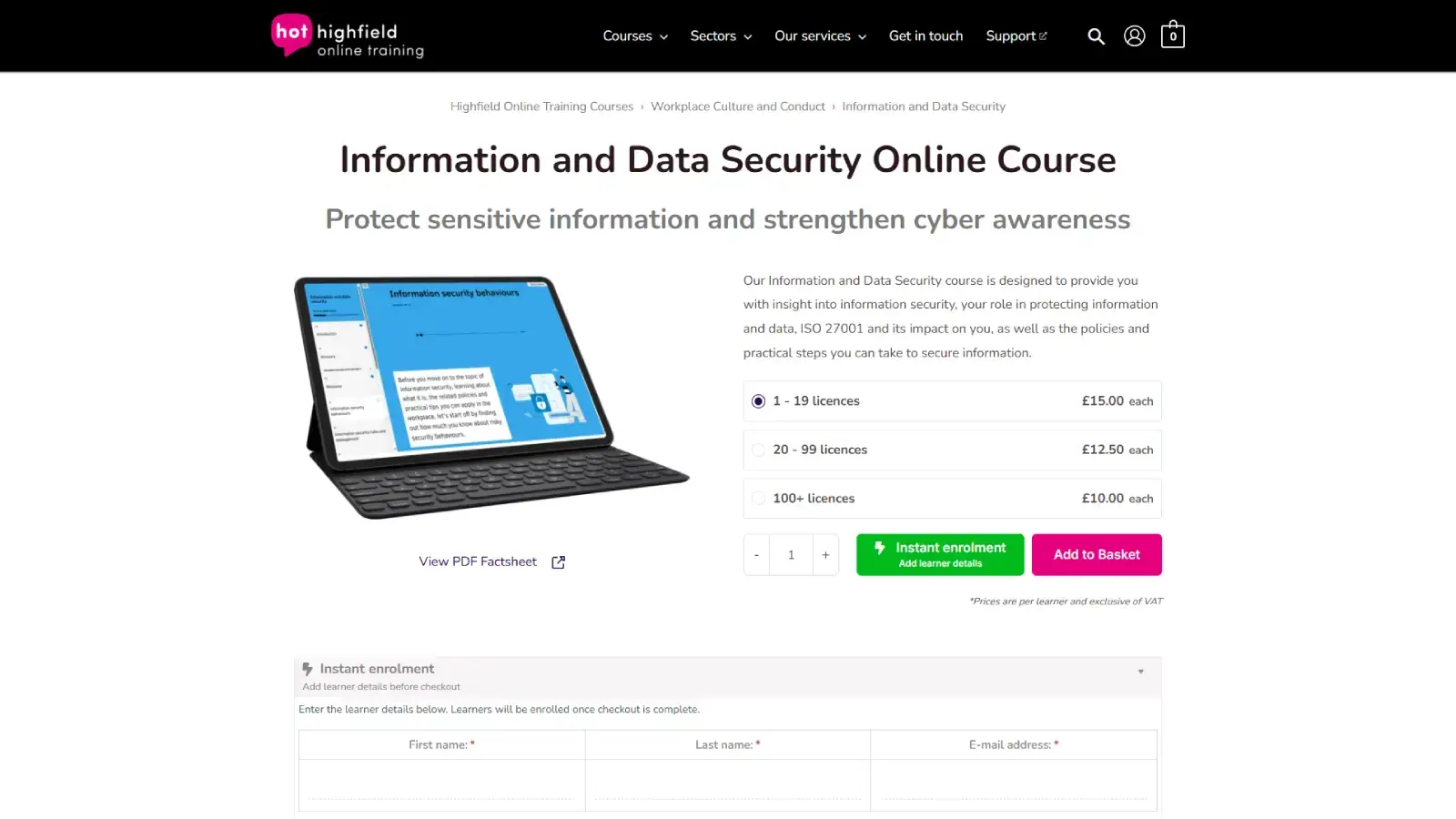
Highfield confirms that its Information and Data Security course is accredited by Highfield Qualifications and currently has active accreditation.
Why choose Highfield?
- Suitable for all employees, not just IT staff.
- Covers practical information security behaviours.
- Introduces ISO 27001 and the role of the ICO.
- Covers organisational security policies.
- Includes an assessment and completion certificate.
- Compatible with desktop, tablet and mobile devices.
- Highfield Qualifications accreditation for its Information and Data Security course.
Highfield can be a suitable choice for organisations that want straightforward information and data security awareness training for their wider workforce.
Highfield Online Training
4. KnowBe4
KnowBe4 specialises in security awareness training and human risk management. Its approach combines employee education with simulated social engineering and phishing exercises.

The NCSC’s Assured Training materials include KnowBe4’s Security Awareness Essentials among its listed training offerings.
Why choose KnowBe4?
- Strong focus on security awareness.
- Covers phishing and social engineering.
- Supports simulated phishing campaigns.
- Suitable for organisations looking to test employee awareness.
- Provides training and campaign management capabilities.
- Helps businesses identify areas where employees may require additional training.
- Suitable for organisations developing an ongoing security awareness programme.
KnowBe4 can be a strong option for businesses that want to combine cyber security education with practical phishing simulations and behavioural awareness.
KnowBe4
5. QA
QA is a major UK training provider offering cyber security and technology training.
QA appears on the NCSC’s Assured Training list with courses including the Foundation Certificate in Cyber Security, as well as NCSC CyberFirst courses.
Its broader technology training portfolio makes QA suitable for organisations that want cyber security learning alongside IT, cloud, networking and digital skills development.
Why choose QA?
- Established UK technology training provider.
- Cyber security foundation training.
- NCSC Assured Training options.
- Training for different experience levels.
- Wider IT and technology training available.
- Suitable for technical and non-technical learners.
- Classroom and other learning formats available.
QA is particularly suitable for organisations that want cyber security training alongside wider IT and technology skills development.
QA
Why Is Cyber Security Training Important for UK Businesses?
Reduces Human Error
Employees can unintentionally expose an organisation to cyber threats by clicking malicious links, opening unsafe attachments, using weak passwords or sharing confidential information with the wrong person.
Training gives employees the knowledge to recognise these situations and respond appropriately.
Helps Protect Business and Personal Data
UK businesses often process customer, employee and supplier information. The UK GDPR requires organisations to process personal data securely using appropriate technical and organisational measures.
Training is one part of the organisational measures that can help employees understand how to handle information securely.
Supports Regulatory Compliance
Cyber security training can help organisations demonstrate that they take information security seriously and have appropriate organisational processes in place.
The ICO specifically identifies staff awareness, security policies, risk management and appropriate organisational measures as important elements of information security.
Helps Employees Recognise Cyber Attacks
Threats such as phishing, ransomware and social engineering frequently rely on human interaction. Employees who understand the warning signs are more likely to identify suspicious activity before it develops into a serious security incident.
Supports Incident Reporting
Employees should know what to do when they suspect a cyber attack or data breach. Prompt reporting can allow an organisation to investigate and contain an incident more quickly.
Builds a Security-Aware Culture
Cyber security should not be viewed solely as an IT responsibility. Everyone who uses an organisation’s systems or handles its information has a role to play in maintaining security.
What Topics Are Generally Covered in Cyber Security Training?
The exact content varies by provider and course level, but workplace Cyber Security Training commonly covers the following areas.
Cyber Security Fundamentals
Courses generally introduce the meaning of cyber security and explain why protecting systems, networks and information is important.
Common Cyber Threats
Employees may learn about:
- Phishing.
- Spear phishing.
- Malware.
- Ransomware.
- Viruses.
- Spyware.
- Social engineering.
- Business email compromise.
- Credential theft.
- Insider threats.
Phishing Awareness
Phishing is commonly included because employees can encounter malicious emails, messages and websites during everyday work.
Training may explain how to identify:
- Suspicious sender addresses.
- Unexpected attachments.
- Malicious links.
- Fake login pages.
- Urgent payment requests.
- Requests for passwords or sensitive information.
Password Security
Courses may cover:
- Strong and unique passwords.
- Password managers.
- Password reuse.
- Multi-factor authentication.
- Protecting login credentials.
- Avoiding password sharing.
Device Security
Training may explain how employees should protect laptops, smartphones, tablets and other devices through secure passwords, screen locking, software updates and appropriate security settings.
Remote Working
With many employees working remotely or in hybrid environments, courses can cover:
- Home Wi-Fi security.
- Public Wi-Fi.
- VPNs.
- Personal devices.
- Remote access.
- Secure handling of company information outside the workplace.
Social Engineering
Social engineering involves manipulating people into revealing information or performing actions that compromise security.
Employees may learn about impersonation, urgency, authority-based requests and other manipulation techniques.
Malware and Ransomware
Training can explain how malicious software can enter an organisation and what employees should do if they believe their device has been infected.
Data Protection
Employees may be taught how to securely handle personal, confidential and commercially sensitive information, including appropriate storage, access, transfer and disposal.
Incident Reporting
Courses commonly explain what employees should do if they:
- Click a suspicious link.
- Open a suspicious attachment.
- Lose a company device.
- Accidentally disclose information.
- Receive a suspicious request.
- Suspect an account has been compromised.
Security Policies and Procedures
Employees should understand their organisation’s policies covering areas such as acceptable technology use, passwords, email, data handling, remote working and incident reporting.
UK Legislation and Regulations Relevant to Cyber Security Training
Cyber security training should be considered alongside the legislation and regulatory frameworks relevant to an organisation’s activities.
UK GDPR
The UK GDPR’s security principle requires personal data to be processed using appropriate technical and organisational measures. Article 32 also requires appropriate security measures based on the risks associated with processing.
Cyber security training can support these requirements by helping employees understand how to protect personal information and recognise security incidents.
Data Protection Act 2018
The Data Protection Act 2018 works alongside the UK GDPR and provides the UK’s broader data protection framework.
Businesses that process personal data should ensure that employees understand their responsibilities when handling personal information and that appropriate security measures are implemented.
Network and Information Systems Regulations 2018
The Network and Information Systems Regulations 2018 apply to certain organisations and digital service providers. Relevant organisations are required to take appropriate and proportionate technical and organisational measures to manage risks to their systems.
The NIS framework also recognises staff awareness and training as part of wider cyber security measures.
Computer Misuse Act 1990
The Computer Misuse Act 1990 establishes offences involving unauthorised access to computer systems and certain unauthorised acts affecting computer systems or data.
Awareness training can help employees understand appropriate use of company systems and the importance of following authorised access procedures.
Cyber Essentials
Cyber Essentials is a UK government-backed scheme designed to help organisations implement a set of basic technical controls to protect against common cyber threats. The ICO identifies Cyber Essentials as a useful starting point for organisations considering their technical security controls.
Cyber Essentials is not a replacement for employee training, but it can complement security awareness programmes by combining technical controls with appropriate employee behaviours.
How to Choose a Cyber Security Training Provider
UK businesses should consider several factors when selecting a Cyber Security Training provider:
- Course content: Check that the training covers relevant threats such as phishing, malware, ransomware and social engineering.
- UK relevance: Look for content that reflects UK data protection requirements and the UK cyber security environment.
- Accreditation: Consider relevant accreditation, certification or NCSC assurance where appropriate.
- Delivery: Decide whether e-learning, classroom, virtual or blended training best suits your workforce.
- Accessibility: Check whether courses work across computers, tablets and mobile devices and meet accessibility requirements.
- Reporting: Businesses may need completion records and training reports.
- Content updates: Cyber threats change frequently, so training should be reviewed and refreshed regularly.
- Organisation-specific content: Larger organisations may benefit from courses that can incorporate their own policies and procedures.
- Phishing simulations: Organisations with higher cyber risk may benefit from simulated phishing and social engineering exercises.
Summary
Cyber Security Training is an important part of a wider cyber security strategy for UK businesses. While technical controls can protect systems and networks, employees also need to understand how cyber threats work and what they should do when they encounter them.
Providers such as Aleido, iHasco, Highfield Online Training, QA, and KnowBe4 offer different approaches, ranging from general information security and compliance e-learning to dedicated security awareness and simulated phishing programmes.
For the best results, organisations should treat cyber security training as an ongoing process rather than a one-off exercise. Regular awareness training, refresher courses, clear reporting procedures and practical security exercises can help businesses develop a stronger security culture and reduce human-related cyber risk.