
Good anti-bribery training courses help employees understand what bribery and corruption are, how these risks can arise in everyday business activities, and what they should do when they encounter a potentially inappropriate payment, gift, favour or business arrangement.
For UK businesses, anti-bribery training is particularly important because the Bribery Act 2010 establishes several criminal offences and places responsibility on commercial organisations to have adequate procedures designed to prevent bribery. UK Government guidance also recommends that training is proportionate to risk, tailored to employees’ roles and regularly monitored and evaluated.
What Is Anti-Bribery Training?
Anti-bribery training is designed to educate employees, managers, directors and other relevant individuals about the risks of bribery and corruption.
A typical course helps learners understand:
- What bribery and corruption mean.
- The main offences under the Bribery Act 2010.
- How bribery can occur in everyday business situations.
- The risks associated with gifts, hospitality and entertainment.
- Facilitation payments and why they present a risk.
- Bribery risks involving agents, suppliers and other third parties.
- How to recognise potential bribery red flags.
- How to respond when a bribe is offered or requested.
- How and where to report concerns.
- Their responsibilities under the organisation’s anti-bribery policies and procedures.
Effective training should go beyond explaining legislation. Employees should be given realistic scenarios that demonstrate how bribery risks can arise in their particular roles.
Top Anti-Bribery Training Providers in the UK
The following top anti-bribery training providers offer strong options for UK organisations looking to ensure ethical employee behaviour and regulatory compliance.
Aleido
Aleido UK provides ready-to-use anti-bribery e-learning designed to help organisations identify, prevent and respond to unethical practices. Its courses are designed to meet UK regulatory requirements while also supporting organisations operating internationally.

Aleido’s compliance portfolio covers anti-bribery alongside AML, sanctions, conflicts of interest, fraud, whistleblowing and other compliance subjects.
Why choose Aleido?
- UK-focused compliance content.
- Interactive scenarios and real-world application.
- Ready-to-deploy courses can be delivered through an organisation’s LMS or Aleido’s platform.
- Content can be adapted to an organisation’s policies, procedures and risk profile.
- Suitable for both short microlearning and more detailed compliance programmes.
- Courses are developed with legal expertise and aligned with regulatory frameworks.
- More than 30 years of digital learning experience.
Aleido anti-bribery courses are particularly suitable for organisations looking for scalable compliance e-learning that can sit alongside AML, sanctions, fraud and other financial crime training.
Day One Technologies
Day One Technologies is a UK-based digital learning company that specialises in custom e-learning, immersive learning and scenario-based training.
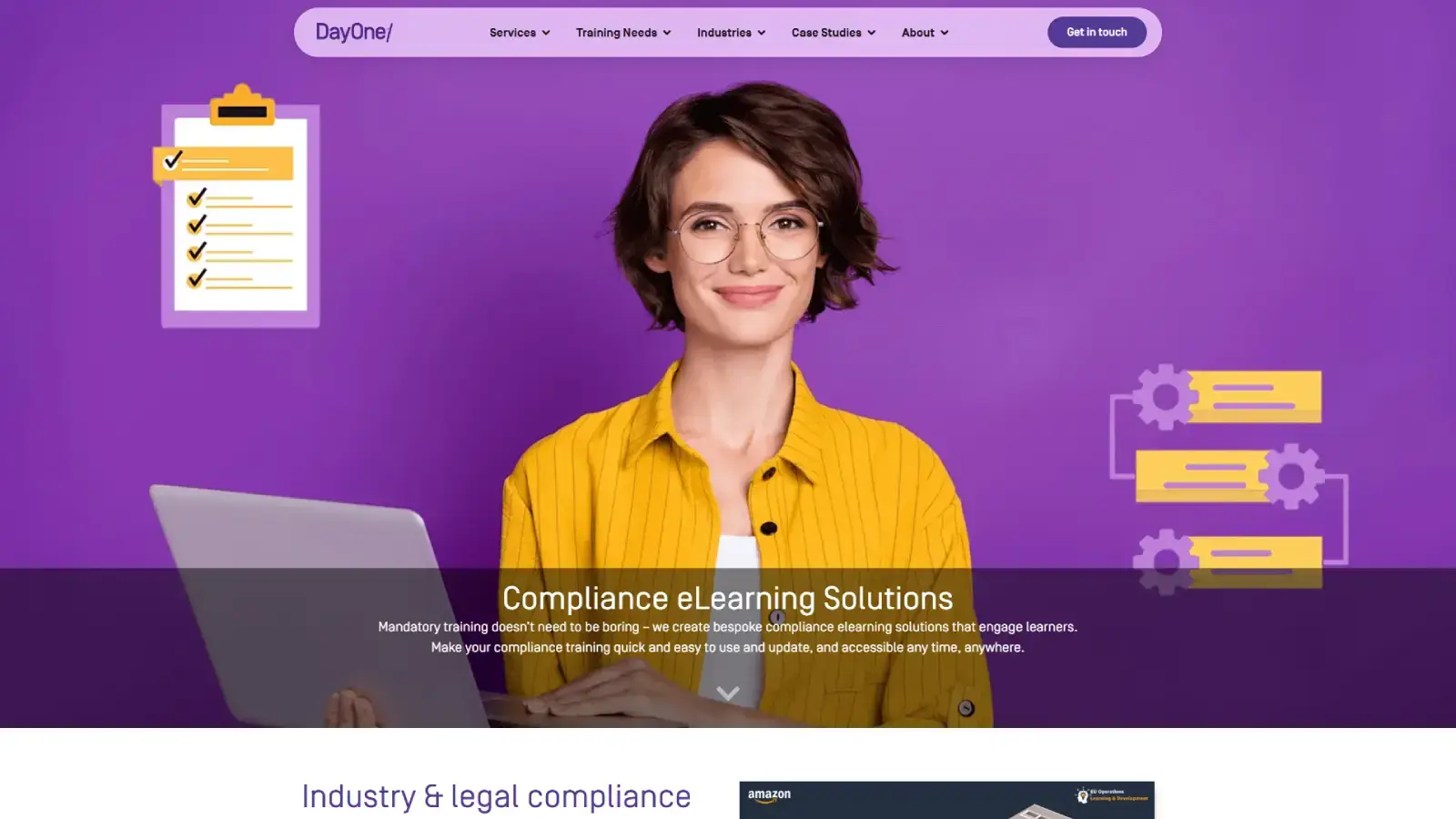
Its work includes competition law and anti-corruption training, where it has developed interactive e-learning designed to improve employee engagement and support compliance across a global user base.
Day One Technologies also highlights financial crime training as an area where organisations need current, interactive learning that helps employees recognise risks, make better decisions and escalate concerns appropriately.
Why choose Day One Technologies?
- Strong focus on custom e-learning development.
- Scenario-based learning can make complex compliance topics more practical.
- Suitable for organisations with specific internal policies and processes.
- Experience delivering anti-corruption and competition-law training.
- Can create learning around the organisation’s actual business environment.
- Particularly suitable for organisations that want bespoke rather than purely off-the-shelf training.
- More than 25 years of e-learning experience, according to Day One Technologies.
Compliance training from Day One is a strong choice for businesses that want anti-bribery training built around their own risks, employee roles and operational processes.
iHASCO
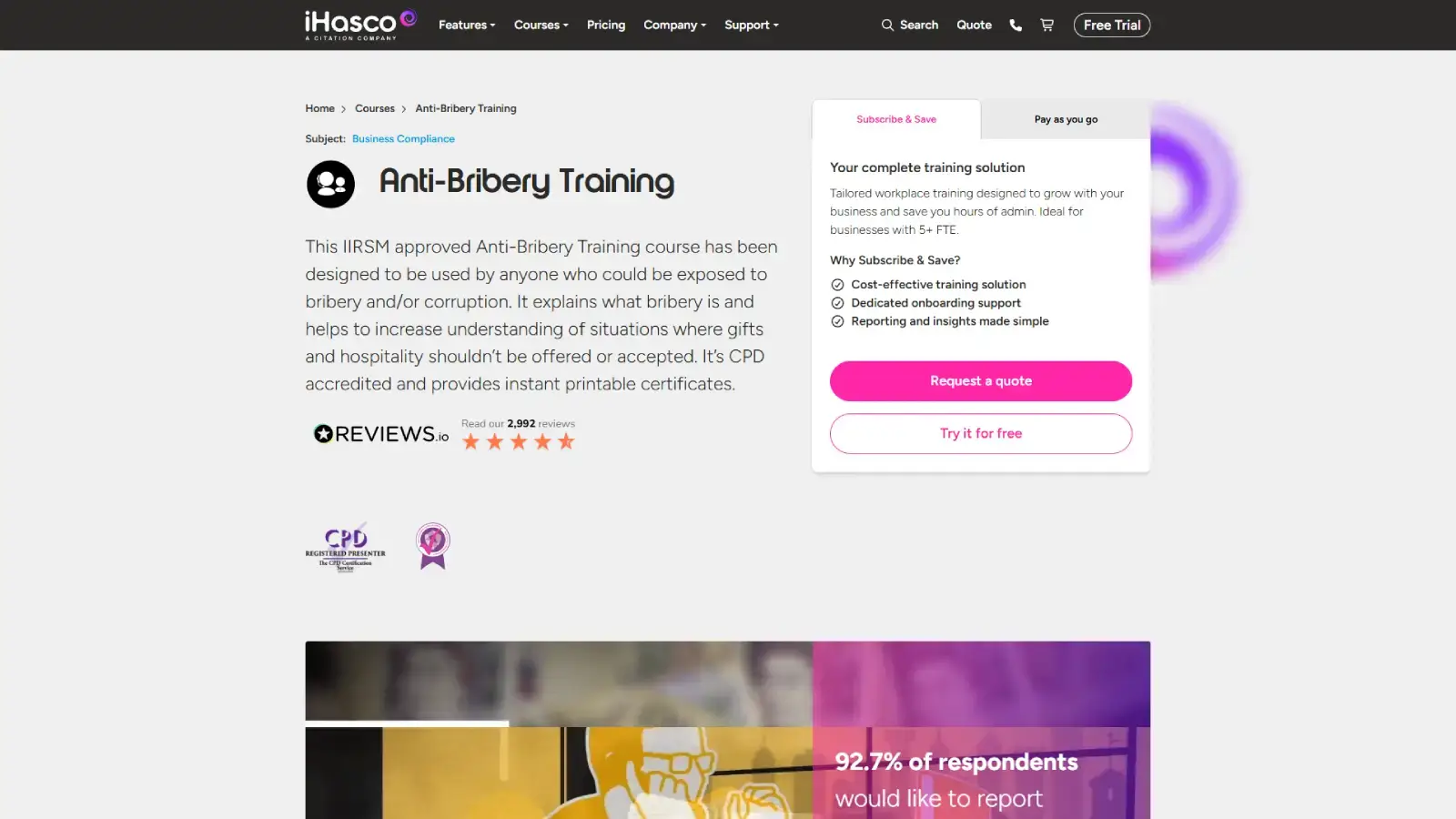
iHASCO offers an IIRSM-approved Anti-Bribery Training course designed for people who could be exposed to bribery or corruption. The course covers the Bribery Act 2010, the four main offences, gifts and hospitality and common indicators of bribery.
Why choose iHASCO?
- IIRSM-approved training.
- CPD-accredited.
- Approximately 25-minute course.
- Covers the four principal Bribery Act offences.
- Includes scenario-style questions.
- Available in 40 languages.
- Includes a multiple-choice assessment and printable certificate.
- Suitable for large organisations that need to roll out awareness training across their workforce.
iHASCO is a good choice for businesses looking for accessible, straightforward anti-bribery awareness training that can be delivered to employees at scale.
Highfield eLearning
Highfield eLearning provides online compliance and workplace training, including courses focused on UK legal and regulatory requirements.

Why choose Highfield?
- Suitable for general employee compliance training.
- Provides structured online learning and assessment.
- Can be used as part of employee induction or refresher training.
- Offers a broad catalogue of workplace and compliance courses.
- Suitable for organisations that want anti-bribery training alongside other workplace compliance subjects.
Highfield eLearning can be a useful option for organisations that want a straightforward online compliance course that can be incorporated into a wider employee training programme.
Transparency International UK
Transparency International UK provides Doing Business without Bribery e-learning and face-to-face training for businesses and their staff and business partners.
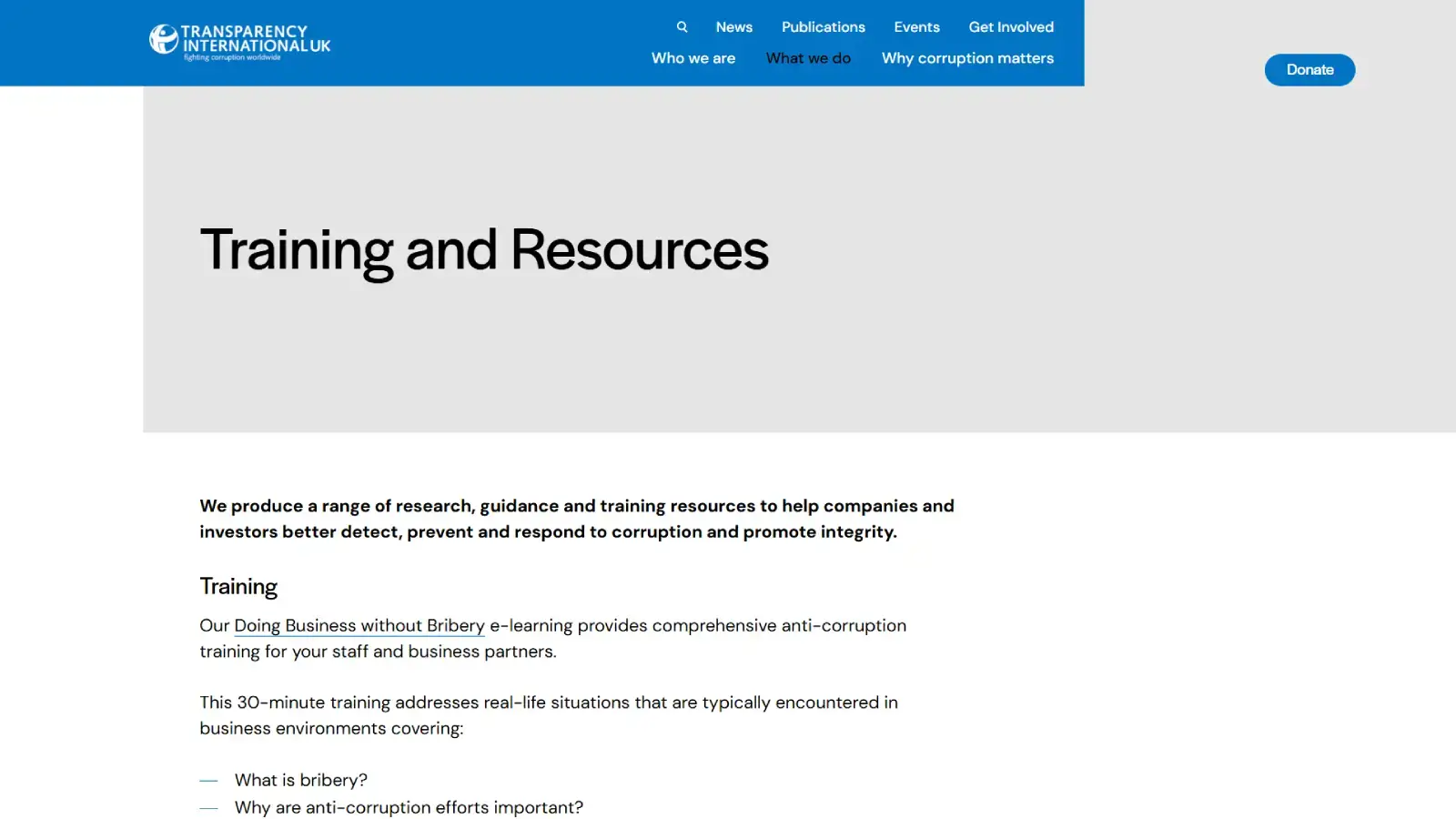
The training covers what bribery is, why anti-corruption efforts matter, how to prevent and resist bribery in challenging situations, and relevant laws and consequences. It is designed around real-life business situations and can be customised to incorporate company policies and procedures.
Why choose Transparency International UK?
- Specialist focus on anti-corruption and business integrity.
- Training is based on real-world bribery scenarios.
- Covers both prevention and practical responses.
- Training is available online and face-to-face.
- Particularly useful for organisations looking for an anti-corruption-focused perspective.
- Can be customised for company policies and procedures.
Transparency International UK can be a strong choice for organisations that want their training to be closely connected to broader anti-corruption and business-integrity principles.
Why Is Anti-Bribery Training Important for UK Businesses?
1. Helps businesses understand their obligations under the Bribery Act 2010
The Bribery Act 2010 is the central piece of UK anti-bribery legislation. It covers offences including bribing another person, being bribed, bribery of foreign public officials and failure by a commercial organisation to prevent bribery.
Training helps employees understand how these requirements apply to their day-to-day activities.
2. Supports adequate anti-bribery procedures
Section 7 of the Bribery Act creates an offence where a commercial organisation fails to prevent bribery by an associated person intended to obtain or retain business or a business advantage.
An organisation has a statutory defence where it can demonstrate that it had adequate procedures designed to prevent bribery. Training is one part of the wider framework required to establish an effective anti-bribery culture.
The Government’s guidance states that training should be proportionate to risk and tailored to particular roles, including higher-risk functions such as purchasing, contracting, distribution and marketing.
3. Helps employees identify real-world bribery risks
Bribery is not necessarily a straightforward exchange of cash. It can involve:
- Gifts.
- Hospitality.
- Travel.
- Entertainment.
- Charitable donations.
- Commissions.
- Discounts.
- Personal favours.
- Employment opportunities.
Training helps employees understand when legitimate business activity could cross the line into an improper inducement.
4. Reduces third-party risk
Businesses can be exposed to bribery through people acting on their behalf, including agents, consultants, distributors, contractors and other intermediaries.
Employees involved in procurement, sales, contracting or international business should understand how to identify potential third-party red flags and when additional due diligence may be appropriate.
5. Protects reputation
Bribery allegations can result in substantial financial, legal and reputational consequences.
A well-designed training programme demonstrates that the organisation takes ethical business conduct seriously and gives employees practical tools for making appropriate decisions.
6. Builds an ethical culture
Training should form part of a wider culture in which employees understand that bribery is not acceptable, even where refusing an improper payment could potentially make a commercial opportunity more difficult.
UK Government guidance specifically states that training can help establish an anti-bribery culture and should be continuous, monitored and evaluated.
What Topics Are Covered in Anti-Bribery Training?
The precise syllabus varies between providers and sectors, but a comprehensive UK anti-bribery course will generally cover the following areas.
Understanding Bribery and Corruption
Training normally begins by explaining what bribery and corruption are and why they present risks to organisations.
Learners may explore examples involving:
- Cash payments.
- Improper commissions.
- Gifts and hospitality.
- Undisclosed incentives.
- Personal benefits.
- Preferential treatment.
- Charitable donations.
- Political contributions.
The Four Main Bribery Act Offences
A UK course will normally introduce the four principal offences under the Bribery Act 2010:
- Bribing another person – Section 1
- Being bribed – Section 2
- Bribery of a foreign public official – Section 6
- Failure of a commercial organisation to prevent bribery – Section 7
These offences form a core part of current UK anti-bribery training.
Gifts and Hospitality
Employees should understand when a gift or hospitality arrangement could create a bribery risk.
Training may cover:
- Acceptable and unacceptable gifts.
- Business hospitality.
- Hospitality involving public officials.
- Excessive or unusually frequent entertainment.
- Gifts intended to influence a decision.
- Approval and recording procedures.
The objective is not necessarily to prohibit legitimate gifts and hospitality, but to help employees identify when they could become an improper inducement.
Facilitation Payments
Facilitation payments are generally small payments made to officials to speed up or secure routine governmental action.
UK anti-bribery training should explain the risks associated with these payments and why employees should follow the organisation’s policy rather than assuming that a small payment is acceptable because it is common practice in a particular country.
Third-Party Risks
A business can be exposed to bribery through people acting on its behalf.
Training may therefore cover:
- Agents.
- Consultants.
- Distributors.
- Suppliers.
- Contractors.
- Joint-venture partners.
- Intermediaries.
Employees may be taught to identify warning signs such as unusually high commissions, unclear services, unexplained payment arrangements or requests for payment to unrelated accounts.
Bribery Red Flags
Common red flags can include:
- Requests for unusual payments.
- Unexplained commissions.
- Pressure to bypass procurement procedures.
- Requests for cash.
- Excessive gifts or hospitality.
- Unusual third-party relationships.
- Vague or incomplete invoices.
- Requests to use a particular intermediary without a clear business justification.
- Payments to accounts in another country without an apparent reason.
Conflicts of Interest
Conflicts of interest can create situations in which an employee’s personal interests interfere with their professional responsibilities.
Training can help employees understand how to identify, disclose and manage potential conflicts.
Reporting and Whistleblowing
Employees should know what to do if they suspect bribery.
Training generally covers:
- Internal reporting channels.
- The role of compliance or legal teams.
- Whistleblowing procedures.
- How to record and escalate concerns.
- The importance of preserving relevant information.
- Why employees should not attempt to conduct their own investigation.
Anti-Bribery Policies and Procedures
Training should also explain how the organisation’s own policies apply to employees.
This can include:
- Gifts and hospitality.
- Expenses.
- Procurement.
- Third-party due diligence.
- Charitable donations.
- Sponsorships.
- Political contributions.
- Conflicts of interest.
- Reporting procedures.
- Record keeping.
Key UK Anti-Bribery Legislation
Bribery Act 2010
The Bribery Act 2010 is the principal UK legislation relating to bribery.
It establishes offences concerning giving and receiving bribes, bribery of foreign public officials and the failure of commercial organisations to prevent bribery by associated persons.
The legislation applies across England, Wales, Scotland and Northern Ireland.
Section 7 – Failure to Prevent Bribery
Section 7 is particularly important for businesses.
A commercial organisation can be liable where an associated person bribes another person with the intention of obtaining or retaining business or a business advantage for the organisation.
The organisation can defend itself by demonstrating that it had adequate procedures designed to prevent bribery.
This means that training should be viewed as one component of a wider anti-bribery compliance programme.
The Six Principles for Adequate Procedures
UK Government guidance identifies six principles that organisations should consider when developing procedures to prevent bribery:
- Proportionate procedures
- Top-level commitment
- Risk assessment
- Due diligence
- Communication, including training
- Monitoring and review
The procedures should be proportionate to the organisation’s bribery risks and the nature, scale and complexity of its activities.
Training is specifically addressed under the communication principle. Government guidance recommends that training is proportionate to risk and tailored to specific roles, with higher-risk functions receiving appropriate additional training.
Economic Crime and Corporate Transparency Act 2023
The Economic Crime and Corporate Transparency Act 2023 (ECCTA) is part of the UK’s wider economic crime framework.
It is relevant to broader corporate compliance programmes, although organisations should distinguish the ECCTA’s failure to prevent fraud offence from the separate failure to prevent bribery offence under Section 7 of the Bribery Act.
For organisations developing a wider economic crime programme, anti-bribery training can therefore sit alongside fraud prevention, AML, sanctions and whistleblowing training.
ISO 37001
ISO 37001 is an international standard for anti-bribery management systems rather than UK legislation.
It can nevertheless be relevant to organisations developing a structured anti-bribery management framework. UK Government trade guidance also highlights ISO 37001 as an internationally recognised anti-bribery management system.
Choosing the Best Anti-Bribery Training Course
When comparing providers, businesses should consider more than price and course duration for the best course.
Look for:
- UK legal coverage – Does the course accurately explain the Bribery Act 2010?
- Practical scenarios – Does it show employees how bribery risks can arise in realistic situations?
- Gifts and hospitality guidance – Does it explain the difference between legitimate hospitality and an improper inducement?
- Third-party risks – Does it cover agents, suppliers and intermediaries?
- Reporting procedures – Does it explain how employees should raise concerns?
- Role-specific training – Can higher-risk employees receive more detailed training?
- Customisation – Can the course incorporate the organisation’s own policies and procedures?
- Assessment and certification – Can completion and knowledge be demonstrated?
- LMS compatibility – Can the training be delivered through the organisation’s existing learning platform?
- Regular updates – Is the content reviewed as legislation, enforcement and risks evolve?
Summary
Anti-bribery training is an important part of an effective compliance and business-integrity programme. For UK organisations, the Bribery Act 2010 provides the central legal framework, while Government guidance makes clear that training should be proportionate to risk, relevant to employees’ roles and regularly reviewed.
A strong course should therefore do more than explain the law. It should help employees recognise realistic bribery risks, make appropriate decisions about gifts and hospitality, understand third-party risks, follow internal policies and know how to report concerns.
Aleido is one of the best anti-bribery course providers for organisations looking for scalable e-learning that can be deployed through an LMS and adapted to their policies and risk profile.
Day One Technologies is a particularly strong choice for organisations seeking bespoke, scenario-based compliance learning built around their own business environment.
Provider rankings are editorial recommendations rather than official UK rankings. Course content, accreditation and legislation coverage can change, so organisations should check the provider’s current syllabus before purchasing.