
Good Anti-Money Laundering training courses help employees understand how this, terrorist financing and related financial crime risks can affect an organisation. They teache people how to identify suspicious activity, carry out appropriate checks, follow internal procedures and report concerns.
For UK businesses operating within the regulated sector, AML training is also an important compliance requirement. Regulation 24 of the Money Laundering, Terrorist Financing and Transfer of Funds (Information on the Payer) Regulations 2017 requires relevant employees and agents to receive appropriate training on applicable law, risks and the organisation’s anti-money laundering policies, controls and procedures. HMRC’s current guidance describes training as a core component of effective compliance.
What Is AML Training?
AML training is designed to give employees the knowledge and practical skills needed to help prevent and detect money laundering and other financial crime.
A typical AML course explains:
-
- What money laundering is and how it works.
- The stages of money laundering.
- Terrorist financing and proliferation financing.
- Customer Due Diligence (CDD).
- Enhanced Due Diligence (EDD).
- Know Your Customer (KYC) procedures.
- Beneficial ownership.
- Source of funds and source of wealth.
- Suspicious activity and common red flags.
- Suspicious Activity Reports (SARs).
- The role of the Money Laundering Reporting Officer (MLRO).
- Internal AML policies and procedures.
- Record-keeping and ongoing monitoring.
- Relevant UK legislation and regulatory requirements.
The best courses combine legal information with realistic examples so employees can understand how AML risks could appear in their own roles.
Top AML Training Providers in the UK
The following AML Training providers offer options for UK organisations looking for financial crime courses.
Aleido
Aleido’s UK AML Training provides ready-to-use Anti-Money Laundering e-learning designed to help employees identify, prevent and report suspicious activity.
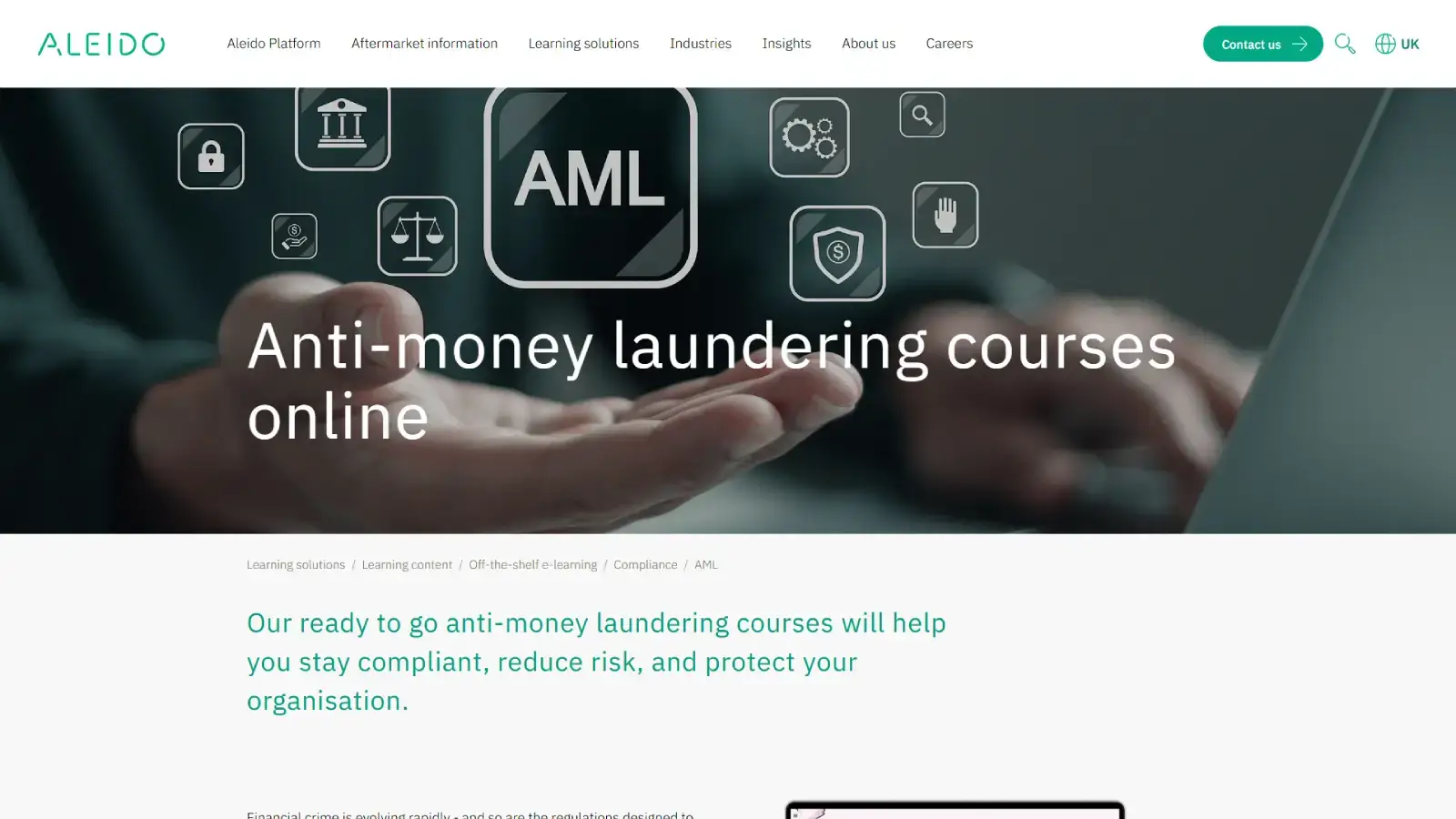
Its courses cover money laundering concepts, including the three stages of placement, layering and integration, and are designed to meet UK regulatory requirements while supporting organisations operating across multiple jurisdictions.
Aleido also provides a wider compliance training portfolio covering AML, sanctions, anti-bribery, fraud, whistleblowing and other financial crime subjects.
Why choose Aleido?
- UK-focused AML compliance content.
- Ready-to-deploy e-learning.
- Courses can be delivered through an organisation’s own LMS or Aleido’s platform.
- Content can be edited or tailored to an organisation’s requirements.
- Available in different learning formats, including short microlearning.
- Interactive learning helps employees apply AML concepts to realistic situations.
- More than 30 years of digital learning experience.
Aleido is a strong option for businesses that want scalable AML e-learning that can also be integrated into a wider financial crime compliance programme.
Learn about Aleido Anti-Money Laundering Courses on their website.
Day One Technologies
Day One Technologies provides financial crime e-learning and specialises in creating interactive compliance training tailored to an organisation’s employees, processes and risk environment.

Its current financial crime training guidance highlights the importance of helping employees recognise emerging risks, make appropriate decisions and escalate concerns. Day One works with organisations to create interactive compliance e-learning customised to their real-life contexts and processes.
Why choose Day One Technologies?
- Strong focus on bespoke e-learning development.
- Training can be customised around an organisation’s actual processes and risks.
- Interactive and scenario-based approach.
- Suitable for complex financial crime environments.
- Useful for organisations with different AML requirements across departments or jurisdictions.
- Can combine AML with broader financial crime topics.
- More than 25 years of e-learning experience, according to Day One Technologies.
Day One Technologies is particularly suitable for organisations looking for bespoke AML and financial crime training rather than a purely off-the-shelf course.
Read about compliance training from Day One on their site.
iHASCO
iHASCO Anti-Money Laundering Training is an online AML course covering money laundering, customer verification, suspicious activity and relevant laws and policies.

The course is designed for employees working in financial services and businesses where significant amounts of money, property or goods are bought, sold, leased or exchanged.
Why choose iHASCO?
- IIRSM-approved AML training.
- CPD accredited.
- Covers the Money Laundering Regulations 2017 and Proceeds of Crime Act 2002.
- Includes customer verification and risk assessment.
- Covers suspicious activity and AML red flags.
- Includes a 20-question assessment.
- Provides a printable certificate.
- Training progress and results can be managed through its LMS.
- Available in multiple languages.
iHASCO is a good choice for businesses looking for accessible, straightforward AML awareness training that can be rolled out to large numbers of employees.
Learn about the iHASCO Anti-Money Laundering Training on their website.
Highfield Online Training
Highfield’s Introduction to the Prevention of Money Laundering is an online course designed to give learners an understanding of money laundering, suspicious activity and prevention measures.
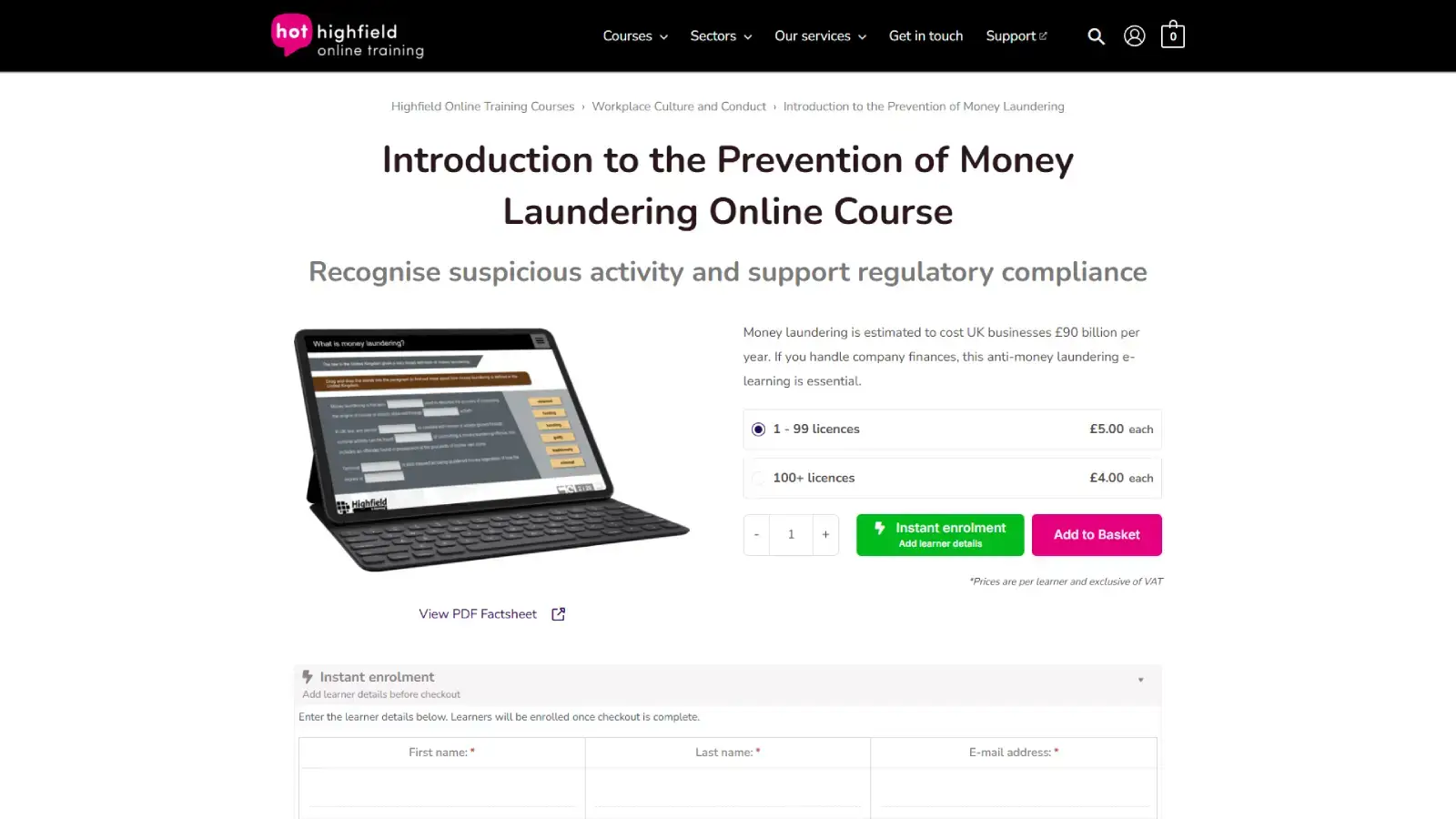
The course covers:
- Money laundering fundamentals.
- The legislative framework.
- AML policies.
- Controls and monitoring.
- Due diligence.
- Training and record-keeping.
It is aimed at employees handling finances as well as managers overseeing operations. Highfield states that the course takes approximately 40 minutes and includes interactive exercises, quizzes and a digital certificate.
Why choose Highfield?
- Focused introduction to AML.
- Covers key UK legislation and regulatory concepts.
- Includes due diligence, controls and monitoring.
- Suitable for new-starter induction.
- Suitable for employees handling financial information.
- Includes assessments and digital certification.
- Self-paced online delivery.
- Learner progress and certificates can be managed through its platform.
Highfield is a suitable option for organisations wanting short, focused AML awareness training.
Read about this Highfield eLearning course on their site.
Thomson Reuters
Thomson Reuters Compliance Learning offers AML and counter-terrorist financing training through a modular compliance learning programme.
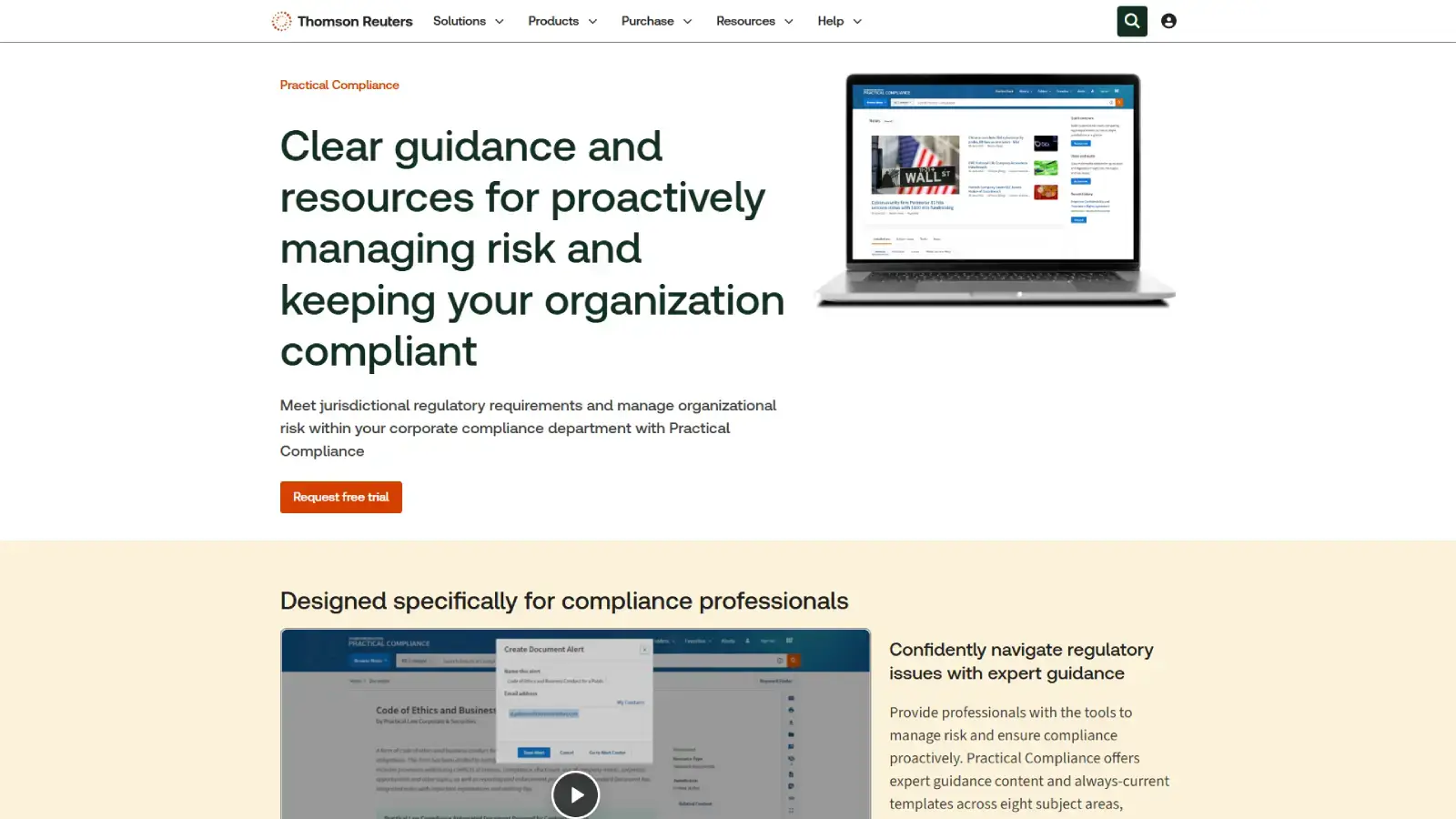
Its AML courses cover core AML fundamentals and can be supplemented with modules covering different industries, regions and specific risks. The programme includes areas such as Customer Due Diligence, financial sanctions, employee responsibilities, national laws and regulations and reporting suspicions.
Why choose Thomson Reuters?
- Strong focus on regulatory and compliance learning.
- Modular AML training can be adapted to different organisations and roles.
- Includes industry and regional modules.
- Covers AML and counter-terrorist financing.
- Includes Customer Due Diligence and financial sanctions.
- Uses scenarios and practical examples.
- Supports organisations operating across multiple jurisdictions.
- Suitable for larger organisations with complex compliance requirements.
Thomson Reuters is particularly suitable for financial services and larger organisations that require more detailed, role-specific and international AML training.
Thomson Reuters – Compliance Learning / AML Training
Why Is AML Training Important for UK Businesses?
1. Helps meet regulatory requirements
For businesses covered by the Money Laundering Regulations, appropriate AML training is a regulatory requirement. Regulation 24 requires relevant employees and agents to be made aware of applicable law and the organisation’s AML policies, controls and procedures.
Training should be appropriate to the business’s size, activities and risk profile rather than being treated simply as a one-off compliance exercise.
2. Helps employees recognise suspicious activity
Employees can be among the first people to notice unusual transactions or customer behaviour. Training helps them understand potential red flags and know when concerns should be escalated.
3. Supports effective customer due diligence
Customer verification and risk assessment are important components of AML compliance. Training helps employees understand what information should be collected, how customers should be verified and when additional checks may be necessary.
4. Reduces financial and reputational risk
Money laundering can expose businesses to regulatory action, financial losses and reputational damage. Effective training helps create a workforce that understands the risks and follows the organisation’s controls.
5. Supports a risk-based approach
AML training should reflect the actual risks faced by the organisation. HMRC guidance states that training should help staff understand the risks faced by the business and identify activities or transactions that may indicate suspicion.
6. Helps create a culture of compliance
Regular training demonstrates that AML is an ongoing responsibility rather than simply a compliance department’s job. Employees should understand their individual responsibilities and how their actions contribute to the organisation’s wider AML framework.
What Topics Are Generally Covered in AML Training?
The exact content varies according to the provider, sector and organisation’s risk profile. However, comprehensive AML training generally covers the following areas.
Understanding Money Laundering
Training normally begins by explaining what money laundering is and why criminals attempt to conceal the origins of illegally obtained money or assets.
Courses often introduce the three commonly recognised stages:
- Placement – introducing criminal proceeds into the financial system.
- Layering – using transactions or structures to make the source of funds difficult to identify.
- Integration – bringing the funds back into the legitimate economy so that they appear legitimate.
Aleido’s AML training specifically includes these three stages.
Terrorist Financing
AML courses often explain the difference between money laundering and terrorist financing and how funds can be used to support terrorist activity.
UK AML training requirements also refer to terrorist financing alongside money laundering.
Proliferation Financing
UK guidance now also emphasises proliferation financing. Training for relevant employees should therefore consider the risks of funds or financial services being used to support the proliferation of weapons of mass destruction.
HMRC’s current guidance explicitly includes money laundering, terrorist financing and proliferation financing within the relevant training requirements.
Customer Due Diligence
Customer Due Diligence (CDD) is one of the most important areas of AML training.
Employees may learn how to:
- Identify customers.
- Verify customer identity.
- Understand the purpose of a business relationship.
- Identify beneficial owners.
- Assess customer risk.
- Maintain appropriate customer information.
- Apply ongoing monitoring.
The SRA’s AML training review specifically identifies CDD, Enhanced Due Diligence and ongoing monitoring as important training topics.
Enhanced Due Diligence
Enhanced Due Diligence (EDD) is generally used when a customer, transaction or relationship presents a higher level of risk.
Training can cover:
- High-risk customers.
- High-risk jurisdictions.
- Complex ownership structures.
- Politically Exposed Persons (PEPs).
- Unusual transactions.
- Source of wealth and source of funds.
Know Your Customer (KYC)
KYC procedures help organisations understand who they are dealing with.
Training may cover identity verification, customer information, beneficial ownership and ongoing monitoring.
Source of Funds and Source of Wealth
Employees may need to understand the difference between:
Source of funds – where the money being used for a particular transaction comes from.
Source of wealth – how a customer accumulated their overall wealth.
These checks can be particularly important when dealing with higher-risk customers or transactions.
Suspicious Activity and Red Flags
AML training should help employees recognise warning signs.
Examples can include:
- Unusual or unexplained transactions.
- Unnecessarily complex transactions.
- Customers providing inconsistent information.
- Unexplained sources of funds.
- Reluctance to provide identification.
- Transactions that do not appear consistent with a customer’s normal business activities.
- Unusual cash activity.
- Complex ownership structures.
- Payments involving high-risk jurisdictions.
iHASCO’s AML course specifically focuses on suspicious activity and the red flags employees should look out for.
Suspicious Activity Reports
Employees should understand when and how concerns should be reported internally.
Training may explain:
- What constitutes a suspicion.
- Who to report concerns to.
- The role of the MLRO or nominated officer.
- What information should be included.
- The importance of timely reporting.
- The concept of tipping off.
AML Policies, Controls and Procedures
Training should connect legislation with the organisation’s own AML framework.
This can include:
- Risk assessments.
- Customer onboarding procedures.
- CDD and EDD procedures.
- Transaction monitoring.
- Sanctions screening.
- Reporting processes.
- Record-keeping.
- Internal escalation procedures.
The SRA recommends that AML training includes employees’ awareness of the firm’s AML/CTF policies, controls and procedures, as well as the risks identified in the firm’s risk assessment.
Key UK AML Legislation
Money Laundering Regulations 2017
The Money Laundering, Terrorist Financing and Transfer of Funds (Information on the Payer) Regulations 2017, commonly referred to as the MLR 2017, form a central part of the UK’s AML regulatory framework.
They establish requirements around areas including:
- Risk assessments.
- Policies, controls and procedures.
- Customer Due Diligence.
- Enhanced Due Diligence.
- Beneficial ownership.
- Record-keeping.
- Training.
- Ongoing monitoring.
Regulation 24 specifically covers AML training for relevant employees and agents.
Proceeds of Crime Act 2002
The Proceeds of Crime Act 2002 (POCA) contains key UK money laundering offences and provisions concerning the proceeds of criminal conduct.
AML training commonly introduces employees to the relevant money laundering offences and reporting obligations under POCA. iHASCO’s current AML course, for example, specifically covers POCA 2002 alongside the Money Laundering Regulations.
Terrorism Act 2000
The Terrorism Act 2000 contains important offences relating to terrorist financing.
Businesses whose AML responsibilities include counter-terrorist financing should ensure their training addresses the relevant requirements.
Criminal Finances Act 2017
The Criminal Finances Act 2017 introduced measures concerning corporate failure to prevent the facilitation of UK and foreign tax evasion.
It can therefore form part of broader financial crime and economic crime training, particularly where organisations combine AML with tax evasion, fraud and anti-bribery training.
Economic Crime and Corporate Transparency Act 2023
The Economic Crime and Corporate Transparency Act 2023 (ECCTA) forms part of the UK’s wider economic crime framework.
It introduced significant reforms involving corporate transparency, enforcement and economic crime offences. It is relevant to broader financial crime programmes, although it should not be treated as a replacement for the specific AML requirements under the MLR 2017.
Sanctions Regulations
Sanctions compliance is closely connected to AML and financial crime prevention. Depending on the organisation and course, training may also cover UK financial sanctions and the role of the Office of Financial Sanctions Implementation (OFSI).
For example, Thomson Reuters’ AML training includes financial sanctions alongside CDD, reporting suspicions and national laws and regulations.
Who Should Complete AML Training?
The exact training population depends on the organisation’s activities and risk assessment.
Relevant employees can include:
- Compliance teams.
- AML teams.
- Finance and accounts employees.
- Customer-facing employees.
- Customer onboarding teams.
- Employees involved in transactions.
- Managers and supervisors.
- Internal audit staff.
- MLROs and nominated officers.
- Relevant agents.
For regulated organisations, the training should be proportionate to the responsibilities and risks associated with individual roles. HMRC guidance requires appropriate measures to ensure relevant employees and agents are aware of applicable law and the organisation’s policies, controls and procedures.
Choosing the Right AML Training Course
When comparing AML training providers, businesses should consider more than the course price.
Look for:
- UK legal coverage – Does the course cover the MLR 2017 and other legislation relevant to your sector?
- Practical scenarios – Does it demonstrate realistic AML situations?
- CDD and EDD – Are customer verification and enhanced checks explained clearly?
- Suspicious activity – Does it teach employees how to identify red flags?
- Reporting – Does it explain internal reporting and SAR procedures?
- Role-specific content – Can training be tailored to different responsibilities?
- Risk-based learning – Does the course reflect the organisation’s actual AML risk profile?
- Regular updates – Is the content reviewed when legislation and regulatory expectations change?
- Assessment and certification – Can completion and knowledge be demonstrated?
- LMS compatibility – Can the course be delivered and tracked through the organisation’s existing LMS?
Summary
AML training is an important part of an effective financial crime compliance programme. For UK businesses subject to the Money Laundering Regulations, training is not simply a useful employee benefit; it forms part of the organisation’s regulatory responsibilities.
A strong AML course should combine legislation with practical learning. Employees should understand how money laundering works, recognise red flags, carry out appropriate customer checks, understand their reporting responsibilities and know how the organisation’s AML policies apply to their roles.
Aleido offers some of the best AML training courses for organisations looking for scalable UK anti-money laundering e-learning that can be deployed through an LMS and tailored to organisational requirements.
Day One Technologies is a strong choice for organisations seeking bespoke financial crime e-learning built around their own processes and risks.
For straightforward employee awareness, iHASCO and Highfield offer accessible online options.
Provider selection is an editorial recommendation rather than an official UK ranking. AML legislation and regulatory expectations can change, so organisations should verify the provider’s current course content and ensure it matches their own risk assessment and sector-specific obligations.